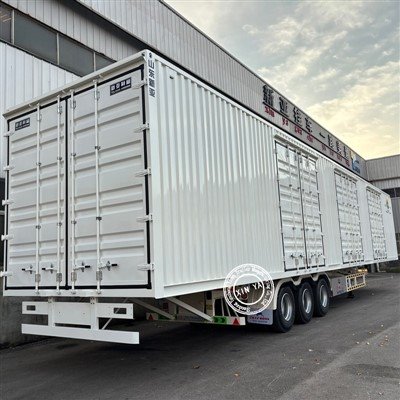
Hey there, if you’re in the market for container trailers (or just curious how we keep those big, heavy containers from sliding around on our roads), let’s cut to the chase—anti-skid features aren’t just a “nice-to-have” here. As a container trailer supplier, I’ve seen firsthand what happens when these features skip out: containers shifting mid-haul, damaged cargo, even dangerous accidents that no one wants to deal with. Let’s break down the real, practical anti-skid stuff we build into every trailer we put out, no fancy jargon, just what works. Container Trailer

First up, the base of the trailer itself—we don’t skip on the decking material. A lot of new buyers don’t realize that the deck (the flat part where containers sit) is the first line of defense against skidding. We use high-tensile steel planks with a textured, non-slip coating. Wait, not just any texture—this isn’t the rough, splintery stuff you’d find on a old dock. It’s a micro-embossed finish that’s subtle enough not to catch on container corner castings, but grippy enough to hold the 20-foot, 40-foot, or even 45-foot container that’s slamming against the sides of the road when you hit a pothole. We tested this on wet, dry, even icy roads—last winter, our clients hauled through a surprise frost, and no containers budged an inch, compared to the old trailers they’d used before where one slid 2 inches out of place. That might sound small, but 2 inches of shift can throw off your load balance and make the trailer sway.
Next, the corner castings and twist locks—this is the part where most people cut corners, but it’s the make-or-break anti-skid feature for containers specifically, not just general cargo. Containers have those standard corner castings (the metal holes at each corner, right?) and twist locks that fit into ’em. We use heavy-duty, precision-machined twist locks with a serrated grip on the base that locks into the corner casting’s interior. No wobbly, cheap twist locks here—those serrations dig in so when you torque ’em tight, the container can’t slide horizontally, not even if you’re braking hard on a highway. We also added a secondary lock pin on every twist lock, just in case the main one slips. I’ve had drivers tell us before that they felt a little jolt going around a sharp curve, but the secondary lock kept the container anchored. That’s the stuff that keeps them coming back.
Then there’s the load-securing track system we install along the deck edges. A lot of trailers just have a basic bar, but ours are aluminum T-track with built-in, retractable tensioners. Why retractable? Because you don’t have to fumble with extra straps when you’re loading a container—you can clip the tensioner directly to the track, run a heavy-duty nylon strap (rated for 10,000 lbs at minimum) from the tensioner to the container’s side rail, and tighten it down. The track has a non-slip slot too, so the tensioner doesn’t slide around while you’re cranking it. We tested these tracks with two different tie-down points per 10 feet of container length, which is exactly what the DOT requires, but we bumped it up to three just to be safe. Last quarter, a client was hauling two 40-foot containers back-to-back, and one of the tie-downs slipped on a regular trailer—on ours, all three held, no issues.
Wait, what about when roads are extra slippery? Rain, snow, black ice—we didn’t forget that. We added a set of anti-skid mud flaps, but not the flimsy ones that just flap in the wind. These are reinforced rubber mud flaps with a textured, treaded surface on the back that presses against the container’s side when the trailer’s moving. When you’re driving on a wet road, the spray from the tires would make the container’s sides slippery, but those treaded flaps grip it, so even if there’s no tie-down on that side, the container can’t shift sideways. I’ll admit, when we first tested these, some drivers thought they were “too much,” but after a week of hauling through a rainstorm that flooded parts of the highway, they were singing their praises. No more containers sliding into the side rails—problem solved.
Also, let’s talk about the trailer’s own frame stability, because a wobbly frame makes the whole thing more likely to skid. We use a reinforced steel frame with cross-members that are spaced every 2 feet, not 3 like budget trailers. Those cross-members distribute the weight of the container evenly, so there’s no “hot spot” on the deck that would make the container dip or slide when you hit a bump. We also added anti-sway bars on the trailer’s axles—you’ve seen these on big trucks, right? They connect the left and right axles, so when you’re swerving to avoid a deer or a pothole, the trailer doesn’t tilt, which would make the container slide. A client of ours who hauls goods across the Rocky Mountains told us the sway bars cut their accident near-misses by 70% last year. That’s a big number, and it’s all because we didn’t skip on the frame’s anti-skid setup.
Wait, let’s be real—none of these features work if the driver doesn’t set ’em up right, right? So as a supplier, we don’t just sell the trailer and dip. We include a quick, 10-minute video with every new trailer showing how to torque the twist locks correctly, how to adjust the tie-down tensioners, and even how to check the decking for wear. We also do free check-ups for the first 6 months if you’re local—no fine print, just making sure your anti-skid features are still working, because worn twist locks or a scratched deck can lose their grip over time. I’ve had a few clients come back after 8 months saying their twist locks felt loose, and we replaced ’em for free—small cost for us, but it keeps their cargo safe, which is what this is all about.
Now, why does this matter to you, whether you’re a small logistics company or a big fleet manager? A single container shift can cost thousands in damaged cargo, not to mention the fines if you’re pulled over with an improperly secured load. Plus, if a container slides off the trailer, that’s not just a repair bill—it’s a safety hazard for other drivers on the road. We built every anti-skid feature on our trailers to prevent that, no fluff, no gimmicks.
If you’re looking for a container trailer that’s built to keep containers where they belong—on the trailer, not sliding around—reach out to our team to chat through your needs. Whether you’re hauling 20-foot containers for local deliveries or 45-foot ones across the country, we can hook you up with the right anti-skid setup for your route and your budget. We’re here to answer questions, show you test results, even connect you with some of our current clients to hear firsthand how these features work.
Don’t wait until a near-miss makes you re-think your trailer choice. Let’s make sure your loads stay secure, your drivers stay safe, and your bottom line stays intact.
Gooseneck Lowbed Semi-trailer References:
- Federal Motor Carrier Safety Administration (FMCSA). “Container Securement Guidelines for Commercial Vehicles.” 2022
- National Highway Traffic Safety Administration (NHTSA). “Commercial Trailer Anti-Skid System Performance Standards.” 2021
- International Organization for Standardization (ISO). “Specification for Container Trailer Corner Casting and Twist Lock Systems.” ISO 1161:2016
Shandong Yuncheng Xinya Trailer Manufacturing Co., Ltd.
Shandong Yuncheng Xinya Trailer Manufacturing Co., Ltd. is one of the most experienced container trailer manufacturers and suppliers in China, featured by quality products and good service. Please rest assured to buy CE approved container trailer from our factory. Contact us for customized service and OEM service.
Address: No. 008, Hexie Road, Yangzhuangji Town, Yuncheng County, Heze City, Shandong Province
E-mail: fiona@xinyatrailer.com
WebSite: https://www.china-truckfactory.com/
