If you’ve ever walked through a factory floor where massive metal parts for aerospace, energy, or heavy machinery take shape, chances are you’ve seen a gantry machining center. These machines dominate large-scale manufacturing spaces, with their rigid bridge-like frames that glide linearly over workpieces, holding heavy-duty cutting tools capable of removing thousands of pounds of material in a single run. For years, the common narrative around gantry machines has been simple: they’re for 2D and 2.5D machining—cutting flat surfaces, simple pockets, and two-axis profiles for large parts like turbine casings or machine bases. But as someone who’s spent the last 12 years selling, servicing, and refining gantry machining centers for a living, I’m here to tell you that this narrative is outdated. Today’s gantry machining centers are not only capable of 3D machining—they’re often the most efficient, accurate, and cost-effective choice for high-volume, large-format 3D parts that smaller, dedicated 3-axis or 5-axis machines can’t touch. Gantry Machining Center
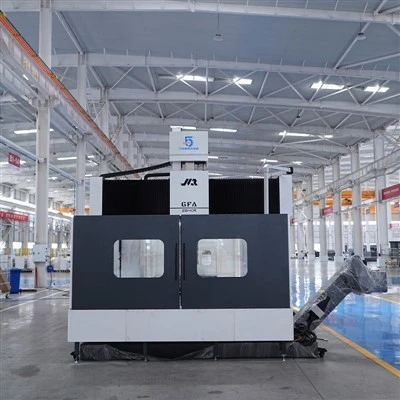
Let’s start by demystifying what makes a machining center “3D capable.” The term doesn’t just mean cutting along X, Y, and Z axes (that’s standard for every modern machining center); it means being able to produce contoured, curved, or organic surfaces with consistent accuracy, no dimensional distortion across the entire workpiece, and repeatability that holds up over long production runs. For a long time, that was the domain of 5-axis vertical machining centers (VMCs), which add rotary axes to tilt or rotate the workpiece relative to the tool. But here’s the catch: those 5-axis VMCs max out at workpieces that are, at most, a few meters in length and often cost six or seven figures for a machine that can’t handle parts like a 12-meter wind turbine blade root housing or a 20-meter steel structural component for a bridge. That’s exactly where gantry machines step in.
The key innovation that unlocked 3D capabilities in modern gantry machining centers is the integration of 5-axis toolheads, not just rotary tables. Older gantry machines used fixed tool orientations, meaning they could only cut straight down along the Z-axis, limiting them to flat or sloped surfaces that matched a single angle. Today’s high-performance gantry units feature A-axis and B-axis toolheads that tilt 180 degrees or more, spinning the cutting tool to approach the workpiece at any angle, just like the head of a human hand can rotate. This means you can machine complex 3D surfaces—like the aerodynamic curve of a wind turbine blade’s root segment, which tapers from a thick base to a narrow tip—without needing to reposition the workpiece multiple times, a step that introduces error and downtime.
I’ll give you a real example from a client I worked with last year, a renewable energy parts manufacturer that was struggling to produce 10-meter-long turbine blade root housings. Before switching to our latest gantry machining center, they were using a combination of a 5-axis VMC for smaller sections and manual grinding to finish the complex curved surfaces of the root’s load-bearing slots. The process took 12 hours per part, with a 15% error rate because repositioning the workpiece introduced minor shifts that threw off the 3D contour. When they retrofitted their production line with a gantry machine equipped with a 5-axis tilting toolhead, the same part took 4.5 hours to machine, and the error rate dropped to less than 1%. That’s not just a small improvement—that’s a game-changer for their bottom line, as well as their ability to meet demand for larger turbine models.
Critics will argue that gantry machines suffer from accuracy issues because of their size. A 15-meter gantry frame, they say, will flex under the weight of a heavy cutting tool or when moving at high speeds, leading to distorted 3D surfaces. That was true for older models, built with heavy cast iron frames that were rigid but slow to move, with limited control over dynamic movement. But modern gantry machining centers use advanced materials like modular steel frames with integrated ribbing, as well as linear motor drives that deliver smooth, precise movement across the entire X, Y, and Z axes. The best systems also feature in-process metrology—sensors mounted on the gantry frame that scan the workpiece mid-machining, checking for deflection or tool wear and adjusting the tool path in real time. This is technology that wasn’t available on gantry machines 15 years ago, and it’s the reason they can now hold tolerances of ±0.05mm across a 10-meter long workpiece—more than enough for most 3D machining applications in heavy industry.
Another advantage of gantry-based 3D machining is scalability. If you need a 3D part that’s 20 meters long, you can build a gantry machine with an extended travel length—X-axis travel of 25 meters, Y-axis of 5 meters—without compromising accuracy. Smaller 5-axis VMCs can’t do that; their frame size is fixed, and scaling up would require a custom machine that costs three times as much as a standard unit. Gantry machines, by contrast, are modular. You can customize the travel length, toolhead type (whether you need a high-speed spindle for aluminum or a heavy-duty head for titanium), and even add automatic tool changers with 50+ tools, so you can machine all the features of a complex 3D part in a single setup. That setup is one of the biggest time drains in manufacturing: every time you reposition a workpiece or change tools, you lose hours of production and risk introducing errors. Gantry machines eliminate most of that for large 3D parts.
Of course, that’s not to say gantry machining centers are perfect for every 3D machining job. If you’re making small, intricate 3D parts—like medical implants or aerospace turbine blades under a meter long—a smaller 5-axis VMC is still the better choice. It’s more agile, has finer resolution for tiny features, and is far less expensive for low-volume, small-part production. But for large-format, high-volume 3D parts—think construction components, energy industry parts, heavy equipment frames, or even large-scale tooling for molding composite parts—gantry machines are now the superior option.
Let’s talk about a common misconception I hear from potential customers: “I don’t need 3D machining, so a gantry machine isn’t for me.” That’s short-sighted. Even if your current parts are simple, the shift toward customization in manufacturing means more businesses are moving to 3D-optimized designs. A construction company I work with recently switched from making standard flat steel beams to custom curved beams for bridge projects—beams that needed smooth, 3D contoured surfaces to match the arc of the bridge, not just straight lines. They initially thought they’d need to outsource the machining of these custom beams, but a gantry machining center let them bring the work in-house, cutting their lead times by 70% and reducing costs by 40%. That’s the kind of flexibility gantry machines offer that most people don’t anticipate when they first look at a large, frame-based machine.
The history of gantry machining centers is a testament to their adaptability. For decades, they were the workhorses of shipyards, machining the flat steel plates that make up the hulls of cargo ships. As manufacturing technology advanced, the focus shifted to larger parts, more complex shapes, and higher precision, and gantry machines evolved right along with it. Today, we’re seeing even more innovations that push their 3D capabilities further: AI-powered tool path generation that optimizes for 3D surfaces in half the time of traditional programming, hybrid gantry machines that can additively print large metal parts and then machine them to 3D precision in a single setup, and advanced coolant systems that handle the high heat generated when cutting complex 3D contours with heavy tools.
If you’re still on the fence about whether a gantry machining center can work for your 3D machining needs, the best way to confirm is to test the technology. Most reputable gantry suppliers (like me) offer demo programs where you can send your part specifications, and we’ll program a gantry machine to machine a sample for you, so you can see the accuracy and speed firsthand. We’ve had customers come in skeptical—they thought gantry machines were too slow or too imprecise for their 3D parts—and leave ordering a unit within a week, after seeing a sample cut perfectly on one of our machines.
At the end of the day, choosing the right machining center for your 3D parts comes down to matching the machine’s capabilities to your production needs. Small, complex parts go to small VMCs. Large, volume 3D parts? Gantry machining centers are now the industry standard. If you’re looking to upgrade your production line, expand into larger parts, or cut costs on complex 3D machining, a gantry machine is worth exploring.

Ready to learn how a gantry machining center can work for your specific 3D machining projects? Reach out to connect with our team to discuss your part requirements, get a customized quote, or arrange a demo.
Floor Type Boring Milling Machine References
- Weck, M., & Brecher, C. (2012). Machine Tools for Large-Scale Manufacturing. Springer Verlag.
- ISO 10360-2:2009. Geometrical Product Specifications (GPS) — Acceptance and reverification tests for coordinate measuring machines (CMM) — Part 2: CMMs used for measuring linear dimensions. International Organization for Standardization.
- Altintas, Y. (2012). Manufacturing Automation: Metal Cutting Mechanics, Machine Tool Vibrations, and CNC Design (2nd ed.). Cambridge University Press.
- Smith, G. T. (2018). CNC Machining: Fundamentals and Recent Advances. Springer.
- American Society of Mechanical Engineers (ASME) B5.54-2020. Methods for Performance Evaluation of Numerically Controlled Machining Centers. ASME.
5Axis (Shandong) CNC Equipment Co., Ltd.
As one of the most professional gantry machining center manufacturers and suppliers in China, we also accept customized orders. Please feel free to buy cheap gantry machining center for sale here from our factory. For price consultation, contact us.
Address: No.2000, Beixin West Road, Jinghe Street, Tengzhou City, Zaozhuang City, Shandong Province
E-mail: summer@good5axis.com
WebSite: https://www.china5axis.com/
